
From Night Classes to National Recognition:
The History of Coastal Carolina University
A Guide for College Student Parents | Approximately 1,500 Words
When your student first told you they were considering Coastal Carolina University, you may have pictured sunny skies and beaches — and you wouldn’t be wrong about the scenery. But behind CCU’s teal and bronze colors lies one of South Carolina’s most remarkable institutional stories: a university that was literally willed into existence by a group of determined citizens meeting in a county library, and that grew, step by deliberate step, into a nationally recognized university of over 11,000 students. Understanding how CCU got to where it is today isn’t just historical trivia — it helps you appreciate what kind of institution your student has chosen to call home.
This is the story of a school that was never handed anything, fought for every stage of its growth, and transformed a region in the process.
Section 1: The Bold Bet of 1954 — Building a College from Scratch
On the evening of July 23, 1954, a group of civic-minded residents gathered at the Horry County Memorial Library in Conway, South Carolina, with a daring idea: to create a college for their community [South Carolina State Library, 2023]. At the time, the Grand Strand region — home to Myrtle Beach and the surrounding coastal communities — had no post-secondary institution. Residents who wanted a college education had to leave, and many simply never went at all.
That meeting produced a nonprofit called the Coastal Educational Foundation, and within weeks the group had secured a partnership with the College of Charleston to launch Coastal Carolina Junior College [Coastal Carolina University Official History, 2024]. The institution opened its doors on September 20, 1954, with just 53 students, a handful of part-time instructors, and classrooms borrowed from Conway High School — classes were held at night to allow working adults to attend [South Carolina Encyclopedia, 2022]. It was, by any standard, a shoestring operation. But it was a start.
When the College of Charleston ended its extension programs in 1958, the school didn’t fold — it found a way. Horry County voters approved a tax increase by a four-to-one margin to keep the college alive as an independent institution, a vote of public confidence that speaks volumes about how much the community wanted this school to exist [South Carolina Encyclopedia, 2022].
So What? For parents, this founding story matters because it tells you something essential about CCU’s DNA. This wasn’t a university created by state mandate or wealthy endowments — it was built by ordinary people who believed education could change their community. That grassroots spirit still shapes campus culture today.
Section 2: The USC Years — Learning to Walk Before Running
By 1959, a more permanent arrangement was needed. The Horry County Higher Education Commission brokered a deal with the University of South Carolina to absorb Coastal as a regional campus — a negotiation famously hammered out at the Chat ‘n’ Chew Restaurant in Turbeville, a small town situated exactly halfway between Conway and Columbia [University of South Carolina Founders Page, n.d.]. It’s the kind of detail that captures the era perfectly: serious business conducted over modest surroundings, with a lot at stake for a small coastal community.
As part of the USC system, Coastal Carolina University gained credibility, resources, and a path toward becoming a four-year institution. Land for a permanent campus was donated in 1961 by the Burroughs Timber Company and International Paper Company, and a major fundraising drive raised $317,000 to break ground [Coastal Carolina University Official History, 2024]. By fall 1963, students moved into the first permanent campus building — what is now known as the Edward M. Singleton Building [Wikipedia, 2025].
The growth that followed was steady and intentional. A third year was added in 1973, a fourth in 1974, and the first bachelor’s degrees were awarded in 1975 [Britannica, 2024]. From a tiny two-year commuter program serving barely 100 students in a borrowed high school, Coastal Carolina University had become a legitimate four-year college in just two decades [University of South Carolina Founders Page, n.d.].
So What? The USC chapter represents Coastal Carolina University’s critical adolescence. Think of it as the years your own student spends in high school — building skills, gaining structure, and quietly preparing for something bigger. The relationship gave CCU what it needed to eventually stand alone.
Section 3: Independence — Becoming a University on Its Own Terms
By the early 1990s, Coastal Carolina University had outgrown its status as a regional branch campus. Enrollment had climbed past 4,000 students, and campus leaders believed the institution had the maturity and momentum to operate independently [South Carolina Encyclopedia, 2022]. In July 1991, the Coastal Educational Foundation and the Horry County Higher Education Commission voted to seek legislative approval for full independence — a bold move that required the support of the very university system they were trying to leave [Coastal Carolina University Official History, 2024].
Remarkably, they got it. USC President John Palms recommended independence to his board of trustees, who approved the measure in June 1992 [Wikipedia, 2025]. On July 1, 1993, Governor Carroll A. Campbell Jr. signed the legislation on the steps of the Singleton Building — the same first building students had moved into 30 years earlier — and Coastal Carolina University became a fully independent state institution [University of South Carolina Founders Page, n.d.]. Ronald R. Ingle, who had served as the last chancellor under the USC system, became CCU’s first president.
The symbolism of that signing location was not lost on anyone who knew the school’s history. From a borrowed classroom in Conway High School to signing legislation on the steps of its own building in under four decades — it was a moment that crystallized everything the institution had worked toward.
So What? Independence wasn’t just administrative housekeeping — it meant CCU could now set its own academic priorities, manage its own finances, and build its own identity. For your student, this means attending a university with a clear, self-directed mission rather than one defined by its relationship to a larger system.
Section 4: A Campus Transformed — Growth, Athletics, and National Recognition
The decades following independence brought rapid transformation. Enrollment reached 7,000 by 2004 — Coastal Carolina University’s 50th anniversary — and continued climbing throughout the 2010s as a locally approved one-cent sales tax for education funded a dramatic building boom across campus [Wikipedia, 2025]. New academic colleges were established, and in 2014, the university launched its first doctoral degree program in coastal and marine systems science, signaling a shift from a teaching-focused college to a research-active university [Wikipedia, 2025].
Athletics played an outsized role in raising Coastal Carolina University’s national profile. The football program launched in 2003, drawing more than 8,000 fans to Brooks Stadium for its inaugural game against Newberry College [Coastal Carolina University Official History, 2024]. But the moment that put CCU on the national map came in 2016, when the Chanticleers baseball team won the College World Series — the university’s first national championship [Wikipedia, 2025]. That same year, CCU’s athletic programs joined the Sun Belt Conference, a major leap in competitive visibility.
By 2017, enrollment had reached 10,600 students, and Coastal Carolina University had earned recognition as a top producer of Fulbright U.S. Students — the only school in South Carolina with that distinction [Wikipedia, 2025]. In 2022, Conway Medical Center made a record $10 million donation to support the new College of Health and Human Performance, reflecting both the institution’s growing stature and its deepening ties to the regional community it was founded to serve [Wikipedia, 2025]. Fall 2025 enrollment broke 11,000 for the first time, and research expenditures had grown 168% over just four years [CCU News, 2025].
So What? For parents evaluating value and trajectory, this section tells a clear story: Coastal Carolina University is a university on an upswing. The combination of academic expansion, research growth, and athletics success mirrors what many mid-sized regional universities experience when they find their footing — and CCU has found its footing decisively.
Section 5: What Makes CCU Unique — Place, Purpose, and Identity
Not every university owns a barrier island. Coastal Carolina University does. Waties Island, a 1,105-acre Atlantic barrier island north of Myrtle Beach, serves as a living laboratory for the university’s marine and coastal science programs — a tangible reminder of the geographic identity that has always shaped this institution [Wikipedia, 2025]. The university is also a designated Sea Grant institution, placing it among a select network of schools with a national mandate to study and protect coastal ecosystems.
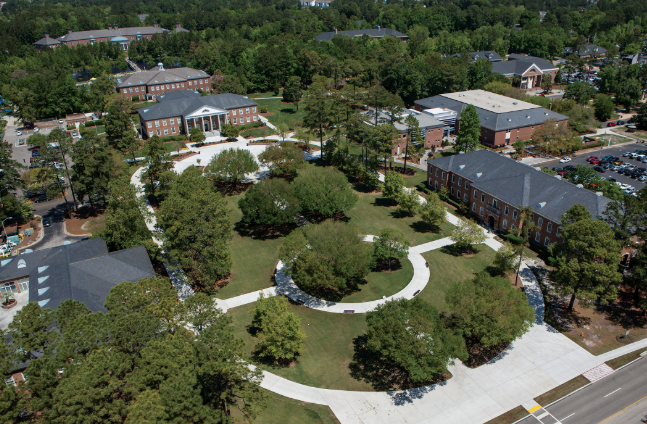
The campus itself, set on 621 acres between Conway and Myrtle Beach, has grown to include more than 115 buildings, the Burroughs & Chapin Center for Marine and Wetland Studies, and the General James Hackler Golf Course — one of only 18 PGA Golf Management programs in the nation [Niche, 2025]. The 17:1 student-to-faculty ratio reflects an environment where students are likely to know their professors by name, a meaningful distinction from large flagship universities [U.S. News, 2026].
With over 120 undergraduate majors and 30+ graduate-level programs — including doctoral degrees — Coastal Carolina University now offers the breadth of a comprehensive university while retaining the community feel of its origins [Niche, 2025]. In 2024, it was named to The Princeton Review’s inaugural Mental Health Honor Roll, one of only 16 schools in the country to earn that distinction — a sign that student well-being is woven into institutional priorities, not just marketing materials [Wikipedia, 2025].
So What? For parents, the “so what” here is simple: your student isn’t just attending a generic state school. They’re attending a place with a specific identity — coastal, community-rooted, research-engaged, and genuinely proud of where it came from. That institutional self-awareness tends to produce meaningful student experiences.
Coastal Carolina University’s history is a story about what happens when a community refuses to accept that it isn’t good enough for higher education. From 53 students in a borrowed high school classroom to a nationally recognized research university with over 11,000 students, Coastal Carolina University has earned every stage of its growth through determined advocacy, strategic partnerships, and an unwillingness to stop reaching.
As a parent, watching your student navigate college can sometimes feel like observing an institution you don’t fully understand from the outside. Knowing Coastal Carolina University ‘s history offers a frame: this is a school that was built by people who cared deeply about their community, fought for their independence, and built something enduring. The same values that drove those 1954 founders to meet in a county library — ambition, practicality, community investment — still animate the institution your student is now part of.
Whatever your student’s major, whatever their goals, they’ve chosen a place that has never stopped trying to become something more. That, more than any ranking or statistic, may be Coastal Carolina University ‘s most distinguishing characteristic.
─────────────────────────────────────────
Further Reading & Sources
Official Coastal Carolina University History Timeline — The university’s own comprehensive timeline, decade by decade:
https://www.coastal.edu/aboutccu/history
South Carolina Encyclopedia Entry on Coastal Carolina University — An authoritative academic overview of the university’s history:
https://www.scencyclopedia.org/sce/entries/coastal-carolina-university
South Carolina State Library — SC University Histories — A broader look at how CCU fits into the state’s higher education landscape:
https://www.statelibrary.sc.gov/in-the-library/history-of-select-south-carolina-universities
Wikipedia — Coastal Carolina University — A well-sourced overview with detailed sections on academics, athletics, and campus life:
https://en.wikipedia.org/wiki/Coastal_Carolina_University
U.S. News Best Colleges Profile — Current rankings, tuition, financial aid, and student outcomes data:
https://www.usnews.com/best-colleges/coastal-carolina-university-3451
CCU Record Enrollment News Release (2025) — The latest enrollment milestone and research growth data:
https://www.coastal.edu/news/fall2025/ccubreakstotalenrollmentrecordforthirdconsecutiveyear
USC Founders Page — Coastal Carolina — The USC perspective on the 33-year partnership that shaped CCU:
https://www.coastal.edu/pe_uc/founders/honorees/universityofsouthcarolina
Local News Via - MyrtleBeachSC.com