


From Shell Mounds to the Shag: How Nine Miles of Coastline Became Home
Introduction
If you’ve lived in North Myrtle Beach long enough, you know the rhythm of the place. The way the smell of salt air hits you the second you crack the car window on Highway 17.
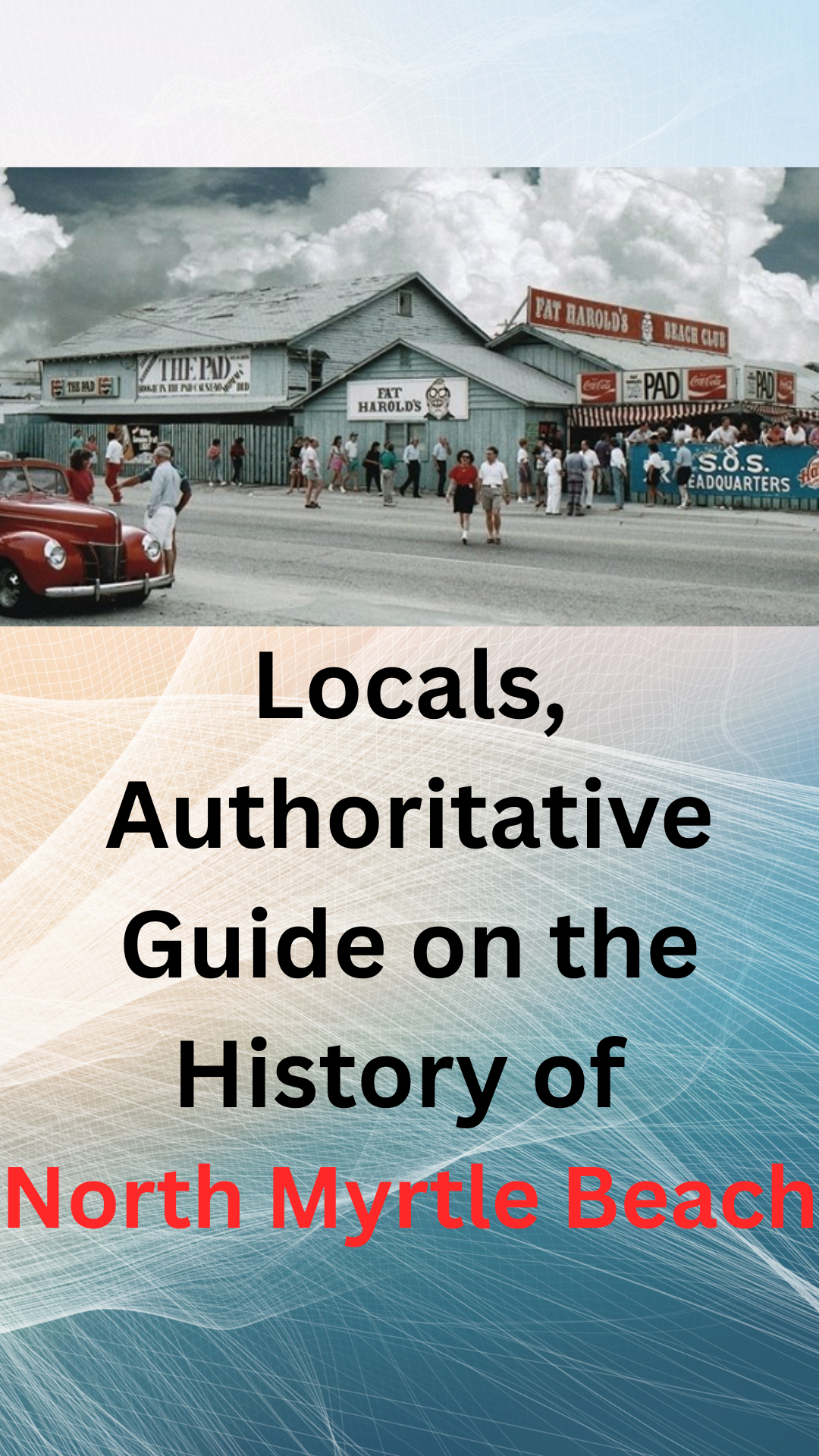
The sound of beach music drifts out of Fat Harold’s on a Tuesday night. There’s a quiet pride in knowing this stretch of coast has a story most tourists never hear.
The sound of beach music drifts out of Fat Harold’s on a Tuesday night. There’s a quiet pride in knowing this stretch of coast has a story most tourists never hear.
North Myrtle Beach is not a suburb of Myrtle Beach. It is not a spin-off or an afterthought. It is a city shaped by ancient peoples, colonial land grants, a catastrophic hurricane, a revolutionary dance, and the deliberate choices of the communities that came before it.
To understand where this city is going, you have to know where it has been — and that story starts long before the first beach house was ever built.
Section 1: The First People and the Long Shadow of Prehistory
Long before any European ever set eyes on the Grand Strand, this stretch of coast was home to the Waccamaw and Winyah peoples.
These were not transient visitors — they were established communities with deep knowledge of the land, the seasons, and the tides [South Carolina Encyclopedia, 2022].
Prehistoric shell deposits scattered throughout the area offer proof of just how long humans have been drawn to this coastline. They used it as a seasonal retreat and a source of sustenance. The same instinct that draws families back to the same rental house every summer has ancient roots here.
This tavern served travelers passing between the Carolinas. A handful of prominent families, among them the Bellamys, Bessants, Nixons, and Vereens, gradually acquired large tracts across the northern strand.
European and African settlement of the northern Grand Strand began in the early eighteenth century. In 1737, a man named William Gause received a land grant for 250 acres near what is now Windy Hill Beach. He farmed the land and established a tavern along the King’s Highway — the colonial-era road running the length of the coast.
He farmed the land and established a tavern along the King’s Highway — the colonial-era road running the length of the coast — serving travelers passing between the Carolinas.
A handful of prominent families, among them the Bellamys, Bessants, Nixons, and Vereens, gradually acquired large tracts across the northern strand.
Unlike the rice-and-indigo plantation culture that dominated further south near Georgetown, the land here was better suited to timber harvesting and naval stores production. As a result, what developed was a culture of small, independent farming supplemented by fishing and logging. This culture was self-sufficient, insular, and proud of its identity.
So what? The absence of a plantation economy here wasn’t just an agricultural accident — it shaped the character of the community.
North Myrtle Beach’s roots are working-class and deeply local. That independence is still visible in the way this city thinks about itself.
Section 2: Roads, Rails, and the Slow Arrival of Tourism
For much of the nineteenth century, the northern strand remained isolated. The towns of inland Horry County — Conway, Loris, Aynor — were where life happened, sustained by tobacco farming that by 1920 had made Horry the top tobacco-producing county in South Carolina.
The beach was a seasonal pleasure, not a destination. Every summer, farmers from western Horry County would make the journey by covered wagon to fish and enjoy the surf.
This old tradition speaks to the region’s relationship with the coast as something almost sacred, not commercial. That changed slowly with the arrival of paved roads and bridges that finally connected Horry County to the rest of the state by automobile.
Once the roads came, so did visitors, and locals quickly adapted. By the 1940s, four distinct communities were taking shape along the northern strand. Cherry Grove Beach emerged from a merger of two older properties in 1950.
An inlet separating Futch Beach from the Nixon family’s land was filled in. To the south, a large tract developed by Charles T. Tilghman, Jr. — a Marion County investor — became an upscale residential enclave characterized by strong deed restrictions and careful planning. Farther south, Ocean Drive Beach and Crescent Beach were developed by investors from Florence, drawing crowds with a pavilion and amusement park.
Windy Hill Beach rounded out the group, developed by Conway investors in the post-World War II years. Simple frame houses on stilts lined the oceanfront. The beach was a place of simple pleasures — summer weeks with family, fishing from the pier, dancing at the pavilion.
It was informal, accessible, and deeply tied to the rhythms of a South Carolina that most people today have never seen.
So what? The four communities that became North Myrtle Beach were never identical. They each had their own investors, their own character, and their own crowd.
That diversity is part of why the eventual merger in 1968 was complicated, and why each neighborhood still carries a distinct identity today.
If there is one thing that most decisively set Ocean Drive apart from every other beach town on the East Coast, it is the Carolina Shag.
And if you live here, you already know the Shag is not simply a dance — it is a worldview, a community, and a way of life that has been unfolding on Main Street for more than eighty years.
The Shag’s origins are rooted in the African American communities of the Grand Strand in the late 1930s [Discover South Carolina]. R&B and what was then called “race music” had a difficult time reaching mainstream radio, so Black communities along the coast established their own open-air pavilions and dance clubs where they could move to the music they loved [Grand Strand Magazine, MPD Cooperative, 2023].
During the era of Southern segregation, something unusual began happening at these clubs. White teenagers — lifeguards, waitresses, college students on spring break — began crossing those racial lines to watch and eventually learn those dance styles [Ocean Drive Resort, 2025].
The adaptation of African American swing dance traditions to the slower, more relaxed tempo of beach music produced something entirely new: the Carolina Shag [Discover South Carolina].
By the 1940s and 1950s, the Shag had found its spiritual home in the Ocean Drive section of what is now North Myrtle Beach.
The clubs along Main Street and Ocean Drive became the proving ground for a dance that was simultaneously smooth and intricate.
It features a six-count eight-step pattern that someone once memorably described as the jitterbug on valium.
In 1984, the South Carolina General Assembly made it official: the Carolina Shag is the State Dance of South Carolina.
The Shag never really stopped. Today, Fat Harold’s Beach Club in North Myrtle Beach hosts free lessons on Tuesday nights.
The Society of Stranders (SOS) draws shaggers from across the country to Main Street North Myrtle Beach twice a year for the Spring Safari in April and the Fall Migration in September.
The North Myrtle Beach Shaggers Hall of Fame sits inside the Ocean Drive Beach and Golf Resort. A Shag Walk of Fame runs along Main Street.
The National Shag Dance Championship, founded here in 1984, continues to bring competitors from across the country.
So what? The Shag is the most honest cultural artifact North Myrtle Beach has produced.
It was born from racial tension and musical cross-pollination. Shaped by the specific geography of this place, it has outlasted every trend, every development cycle, and every demographic shift.
It is the city’s truest inheritance — and it belongs to everyone willing to step onto the floor.
On the morning of October 15, 1954, everything changed.
Hurricane Hazel made landfall as a Category 4 storm near Little River — directly on top of what is now North Myrtle Beach — at approximately 9:20 in the morning.
It carried sustained winds of 130 miles per hour and a storm surge that, coinciding with the highest lunar tide of the year, reached between fourteen and seventeen feet along the northern strand.
The results were catastrophic.
The Horry County Archives document the precise arithmetic of the destruction: 450 homes destroyed in Ocean Drive alone, 300 at Cherry Grove Beach, 200 at Crescent Beach, and 120 at Windy Hill.
A three-story hotel and an 800-foot pier were swept into the Atlantic.
The four communities that would one day become North Myrtle Beach were effectively erased from the oceanfront.
Hurricane Hazel made landfall as a Category 4 storm near Little River — directly on top of what is now North Myrtle Beach — at approximately 9:20 in the morning, carrying sustained winds of 130 miles per hour and a storm surge that, coinciding with the highest lunar tide of the year, reached between fourteen and seventeen feet along the northern strand [WMBF News, 2019].
The results were catastrophic. The Horry County Archives document the precise arithmetic of the destruction: 450 homes destroyed in Ocean Drive alone, 300 at Cherry Grove Beach, 200 at Crescent Beach, and 120 at Windy Hill [Coastal Carolina University Digital Commons].
A three-story hotel and an 800-foot pier were swept into the Atlantic [City of Myrtle Beach]. The four communities that would one day become North Myrtle Beach were effectively erased from the oceanfront.
What happened next is as instructive as the storm itself. Local leaders and the chamber of commerce mounted an immediate and aggressive response.
They announced publicly that the Grand Strand would be open for the 1955 summer season — and it was.
The rebuilding process, guided by a combination of necessity and opportunity, produced a fundamentally different landscape.
The simple frame cottages that Hazel had obliterated were replaced, in many cases, by hotels and larger structures.
The storm that destroyed so much also, inadvertently, laid the physical foundation for the resort economy that followed.
So what? Hazel is a reminder that this city has been rebuilt before — and rebuilt well.
Every time you look at a multi-story hotel on the oceanfront, you are looking at a decision made in the aftermath of a disaster.
The capacity to rebuild with intention is part of what North Myrtle Beach is.
Barefoot Landing opened as an entertainment and retail district anchored on the Intracoastal Waterway.
It offered a model of tourism development that drew visitors without putting more pressure on the oceanfront.
The Alabama Theatre brought live entertainment to Windy Hill.
The Cherry Grove Pier — rebuilt since Hazel — remains one of the most popular fishing spots on the Grand Strand at 985 feet into the Atlantic.
The 1960s brought a tourism boom across the northern strand.
Expanding golf courses began extending the beach season into spring and fall, pulling in visitors who weren’t just there for the summer.
By 1968, the logic of shared infrastructure, shared services, and shared identity had become undeniable.
On that year, Cherry Grove Beach, Ocean Drive Beach, Crescent Beach, and Windy Hill Beach formally consolidated into the City of North Myrtle Beach.
One community chose to stay out: Atlantic Beach, a historically Black resort town bordered on three sides by North Myrtle Beach, declined the invitation to join and has remained an independent municipality to this day.
The decades that followed tested the city’s infrastructure in ways the founders of the merger probably didn’t anticipate.
Beginning in the 1970s, multi-story condominiums and hotels began replacing single-family oceanfront homes at a rapid pace.
Wetlands at Cherry Grove were drained and filled through the excavation of numerous channels to enable further residential development.
By the early twenty-first century, the surge in housing units had pushed local roads, utilities, and public services to their limits.
The 2020 census counted 18,790 permanent residents, but the city’s population swells dramatically every summer — North Myrtle Beach hosts over 15 million visitors annually.
Barefoot Landing opened as an entertainment and retail district anchored on the Intracoastal Waterway, offering a model of tourism development that drew visitors without putting more pressure on the oceanfront.
The Alabama Theatre brought live entertainment to Windy Hill.
The Cherry Grove Pier — rebuilt since Hazel — remains one of the most popular fishing spots on the Grand Strand at 985 feet into the Atlantic [allamericanfireusa.com, 2025].
So what? Growth has been both the city’s greatest opportunity and its most persistent challenge.
The question North Myrtle Beach faces now is the same one it has faced since the 1970s: how do you grow in a way that doesn’t consume the very qualities that made this place worth coming to in the first place?
There are no easy answers. But a community that has survived a Category 4 hurricane, navigated segregation, built a dance into a state institution, and merged four rival towns into one city is not without resources for the challenge.
Conclusion
North Myrtle Beach is nine miles of coastline, but it is also a layered story — of Indigenous peoples who understood this land before anyone else did, of colonial farmers and innkeepers who built lives at the edge of the Atlantic, of Black musicians and white teenagers who accidentally created a state treasure out of a shared love of music.
It is a city that literally rebuilt itself from rubble and chose to do it bigger.
The consolidation of 1968 gave the city its name and its governance, but the community’s character was formed long before that — in the pavilions, on the dance floors, in the fishing boats, and in the storm shelters.
If you grew up here or chose to make this place home, you are part of a story that goes back thousands of years. This is not nothing. This is everything — North Myrtle Beach.
Further Reading
Below are the primary sources consulted for this article. Each is worth exploring in full.
Local News Via - MyrtleBeachSC.com