
Article Via homeguidemyrtlebeach.com
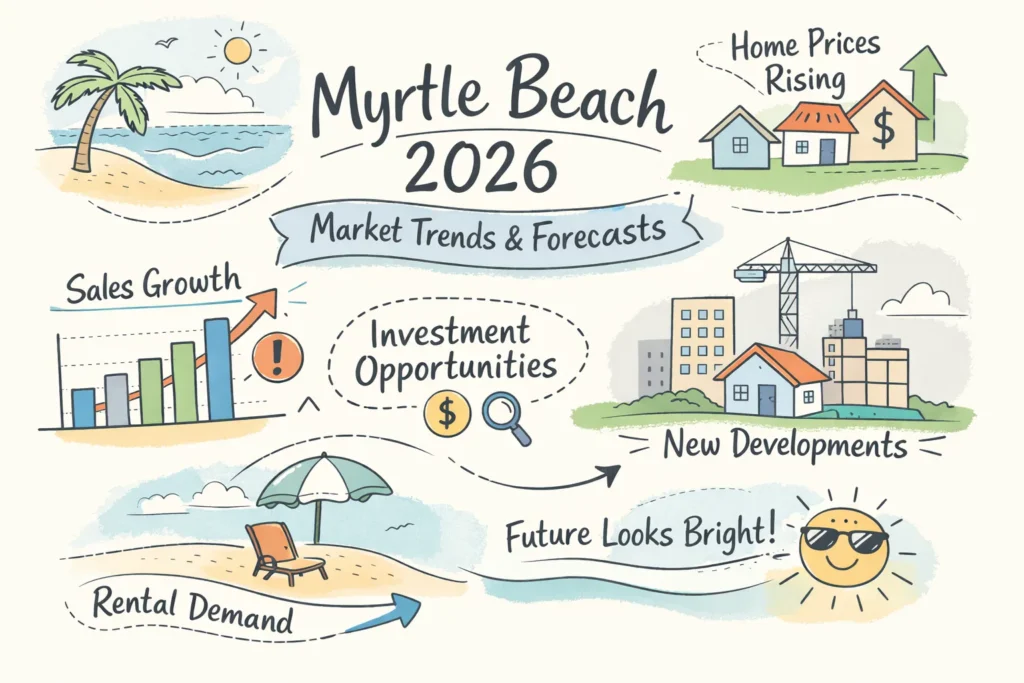
Myrtle Beach real estate enters 2026 with a clear split between headline figures and on-the-ground activity; overall numbers hide meaningful variation across the Grand Strand.
Those mixed signals matter for buyers and sellers because they point to heavier activity in smaller units and condos, which can push the median up while lowering the price per square foot. Sellers should price to neighborhood comparables and account for longer marketing times in some segments. Data feeds differ: Zillow and Redfin often show list-price trends, while the local MLS records final sales and contract details. Rely on MLS data and a customized comparative market analysis from a Jerry Pinkas agent to map the right strategy for your property and timeline.
What you need to know
- Price snapshot: January 2026 median sale price is $274,000, up 10.5% year over year, while price per square foot fell 8.1%. That split reflects greater activity in smaller units and condos than in larger single-family homes.
- Market split: Strong condo and smaller-unit transactions are lowering the price-per-foot even as the overall median rises. Expect divergent trends for Myrtle Beach condos versus single-family homes as buyers chase different product types.
- Inventory and timing: Active listings were about 2,640; single-family inventory slipped to roughly 4,700; and days on market ranged from about 64 to 144, depending on neighborhood and property type. Those differences make timing and local comps more important than broad-market headlines.
- Costs and regulations: Budget for taxes (Horry County assessment ratios differ for primary and second homes), HOA fees and insurance, and check short-term rental rules. North Myrtle Beach requires permits and a local responsible agent, while Myrtle Beach limits STRs to designated zones, so confirm municipal and HOA rules early.
- Action plan: Use local MLS data and a customized CMA from a Jerry Pinkas agent, run a free home valuation, shortlist two to three neighborhoods,s and schedule a 15-minute strategy call. Those steps help align price, timing, and marketing with your goals.
2026 market snapshot: Myrtle Beach real estate prices, inventory, and days on market
The January 2026 numbers show a median sale price of $274,000 and a median price per square foot of $254. A 10.5% year-over-year rise in the median price, alongside an 8.1% decline in price per square foot, suggests a shift toward smaller units or stronger condo sales rather than uniform price growth across all property types. Use these figures as a starting point and compare them to neighborhood-level comps when reviewing specific listings. You can also check home values for Myrtle Beach for an additional portal-based perspective on local valuation trends.
Inventory and time-to-contract vary by market slice. Active listings were about 2,640 in late February 2025, and single-family inventory fell from roughly 5,400 in September 2025 to about 4,700 by January 2026. Locally, days on market average near 103 but range widely by neighborhood and property type, creating negotiating room for buyers in slower segments; sellers of larger homes should price to nearby comps and consider targeted updates that support a higher price per square foot.
Neighborhoods to watch: where to buy, retire, or invest on the Grand Strand
Market Common and Surfside attract retirees and lifestyle buyers who want walkable streets, on-site amenities, and low-maintenance condos and townhomes. These areas provide convenient access to grocery stores, dining, and local services, and HOA-managed communities reduce yard work and upkeep. Pricing runs above the broader Grand Strand median, with many townhomes and condos listing between about $250,000 and $500,000, making competition stronger for buyers focused on convenience and community.
Carolina Forest and Conway are growth corridors favored by families and remote workers because of newer construction, larger lots, and access to schools. Typical single-family prices generally fall between $300,000 and $450,000, with new builds carrying a modest premium of roughly 5 to 10 percent depending on finishes. These neighborhoods offer more square footage per dollar than core beach communities and tend to hold value for homes with dedicated office space and modern floor plans.
North Myrtle Beach, Arcadian Shores, and oceanfront areas draw investors and short-term rental owners due to seasonal demand and direct beach access. Rental-ready inventory often includes turnkey two- to three-bedroom condos in elevator buildings, commonly priced between $350,000 and $650,000. Pay close attention to HOA restrictions, parking, and management fees, since operating costs directly affect net seasonal income.
Each pocket of the Grand Strand matches a clear buyer profile: low-maintenance living for retirees, room and schools for families, or rental upside for investors. Compare active Myrtle Beach MLS listings side by side and use financing and rental projections to choose neighborhoods that match your timeline and goals.
Ownership costs you need to budget for: taxes, HOA, and insurance
Horry County taxes depend on how you use the property. The county applies an assessment ratio of 4 percent for primary residences and 6 percent for second homes; after applying the local millage rate,s the effective tax burden typically ranges from about 0.35 percent to 0.53 percent of market value. That difference means second homes generally carry higher tax bills than primary residences and should be factored into monthly budgeting.
Worked examples make the math practical. For a $300,000 primary home (4 percent assessment), the assessed value is $12,000, and annual taxes would run roughly $1,050 to $1,590 using typical millage rates. For a $300,000 second home (6 percent assessment) the assessed value is $18,000 and taxes increase by roughly 50 percent, to about $1,575 to $2,385 per year unless local millage rates change (see recent coverage of local millage rate changes).
HOA fees vary by property type and location. Condos and beachfront communities commonly charge $50 to $300 per month, while inland single-family neighborhoods often charge $0 to $150 per month. Fees usually cover exterior maintenance, common-area insurance, pools, and landscaping, so always request the HOA budget, reserve study, and recent meeting minutes to check reserves and identify likely special assessments.
Insurance costs depend on exposure and elevation. Properties in VE or AE flood zones often require National Flood Insurance Program coverage and can carry flood premiums from a few thousand dollars to well over $10,000 annually, while inland homes commonly pay between $500 and $2,000 for flood protection. Coastal properties also face higher wind and hurricane premiums, so combined wind and flood insurance on waterfront units often totals several thousand dollars a year, depending on elevation and deductible; obtain written premium estimates, ask for elevation certificates, and factor mitigation credits into your budget before you sign.
Short-term rentals and investor checklist: rules, yields, and red flags
Start with regulatory checks before you price a deal. North Myrtle Beach short-term rental rules require an annual short-term rental permit and a local responsible agent, while Myrtle Beach limits short-term rentals to designated commercial or tourist zones. Every operator must register to collect and remit accommodations taxes, and HOA restrictions or incompatible zoning are common deal breakers. Confirm permits, tax registration, and HOA rules before you sign a contract.
Estimating yield starts with reliable occupancy and rate data. Use AirDNA or local property manager comps to build a seasonally weighted revenue model, then subtract running costs such as cleaning, utilities, insurance, platform fees, and HOA dues. Given the local context—median sale price around $274,000 and median price per square foot near $254—validate seasonal demand and financing targets with a local agent who knows which months drive bookings.
Watch for investor red flags and verify them before signing the contract. Common deal breakers include HOA bans or minimum-stay restrictions, parking limits or municipal noise enforcement, prohibitively expensive or unavailable insurance for STRs, and neighborhood complaints or litigation tied to rentals. For each issue, secure supporting documents and written quotes so problems surface during due diligence rather than after escrow.
- HOA bans or minimum-stay restrictions. Request the full HOA rules and the most recent meeting minutes.
- Parking limits or municipal noise enforcement. Confirm guest parking allocations and check for recent citations.
- Insurance availability and cost. Secure a written quote from a carrier experienced with short-term rentals.
- Neighborhood complaints or litigation. Review court records and speak with local property managers and neighbors.
Run this checklist as part of your due diligence and include findings with your offer so issues are flagged before escrow. A local Myrtle Beach condo specialist can provide a templated checklist and a neighborhood suitability review to speed up underwriting and decision-making.
2026 forecast: scenarios, drivers, and market signals to watch
Plan for a base case and two contrast scenarios: an upside tied to stronger tourism and net migration, and a downside driven by rising insurance costs or higher interest rates. The base case calls for steady growth of roughly 3 to 4 percent annually, which will favor buyers who plan to hold for five years or more. If tourism and net migration accelerate, the upside would bring faster price gains, stronger rent growth, and shorter days on market, while a downside shock to insurance or rates would reduce affordability and compress investor returns.
Track a handful of leading indicators over the next six to 12 months. Mortgage rates matter most because rising rates reduce buying power and falling rates open buying windows. Also watch months of supply, pending sales, new construction permits, and days on market; shrinking supply with rising pendings signals a seller’s market, while rising days on market point to more negotiating leverage for buyers.
Use these scenarios to align action with timeline and risk tolerance. Buyers planning to live in a property long term may follow the base case and move now, while investors focused on short-term cash flow should stress-test returns against the downside and require higher cap rates. Sellers should consider listing when inventory tightens seasonally, and pendings climb.
How to act now: budgets, live-search tools, and working with local agents
Start by building a realistic monthly budget to understand your true ownership costs. Below are two sample breakouts you can copy and adjust with your own loan terms and insurance quotes.
- $300,000 inland single-family (example). With a 30-year mortgage at 6.5% and 20% down, the principal and interest payment is about $1,517 per month. Add property taxes (~$150), homeowners’ insurance (~$100), maintenance at about 1% per year (~$250), and optional property management (~$200) to reach an estimated monthly total of about $2,220.
- $500,000 beachfront scenario. With the same financing assumption,s the mortgage payment is about $2,528 per month. Including taxes (~$292), homeowners’ insurance (~$333), flood insurance (~$200), HOA fees (~$900), maintenance (~$417), and property management (~$600), the estimated monthly total is roughly $5,300.
Use live-search tools to find listings faster: check the local MLS, aggregated portals such as new home market data and interactive maps, and run a free home valuation to prioritize neighborhoods. Save three filters that matter most to your search—FEMA or elevation zone, HOA rules and fees, and short-term rental permissions—and save them as live searches so new matches arrive in your inbox automatically. Those saved searches speed up touring and let you react quickly to price adjustments or pending sales.
A recent client wanted a low-maintenance vacation rental but encountered HOA and insurance barriers. A Jerry Pinkas agent used local comps, the interactive map, and targeted negotiations to find a compliant unit, secure favorable terms, and introduce a vetted property manager plus permitting help.
Your next steps in Myrtle Beach real estate
Budget for taxes, HOA, and insurance, and work with a local agent to model those numbers. Run a free home valuation on the Jerry Pinkas Real Estate Experts website, use the interactive map to shortlist two to three neighborhoods, and book a 15-minute strategy call with one of our agents; the team brings 20 years’ experience and nearly $987 million in sales history to every client. You have questions, we have answers. This is what we do every day. Just give us a call!
Article Via homeguidemyrtlebeach.com